Below are detailed business cases involving Control Percentage (PCON) and Interest Percentage (POWN).
Business case 1
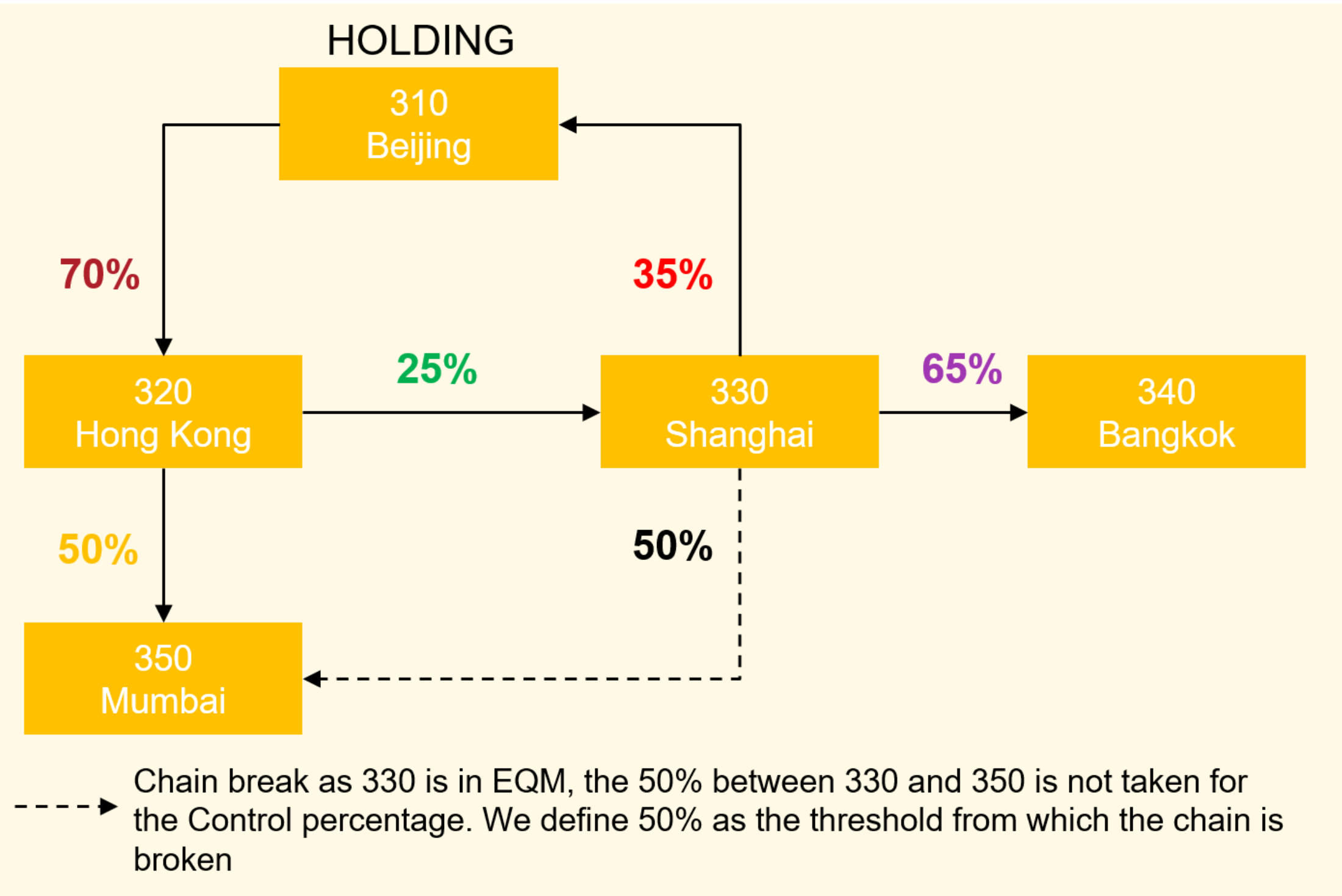
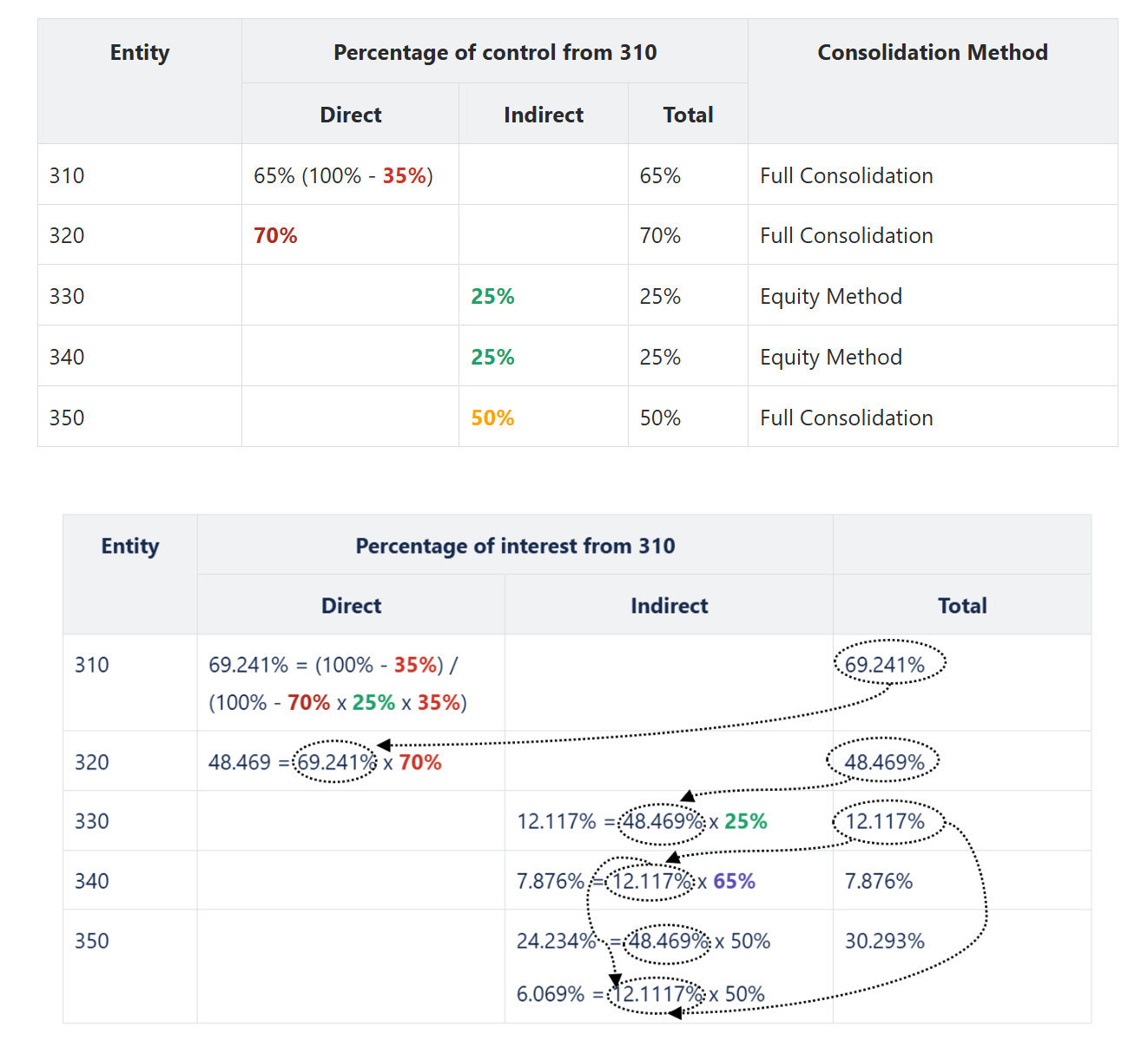
- 310: As there's a 35% detention held by subsidiary 330, the Control % can't be 100%.
- 320: 310 has a direct 70% detention, so Full Consolidation.
- 330: 320, which is fully consolidated, has a 25% detention on 330 using Equity Method.
- 340: 330 has a 65% detention on 340, but as 330 is already in Equity Method (EQM), then 340's Control % is 25%.
- 350: There are two branches.
- The first is via 320 and 350.
- The second is via 320 and 330.
Only the branch with 320/350 is kept for Control %.
Business case 2
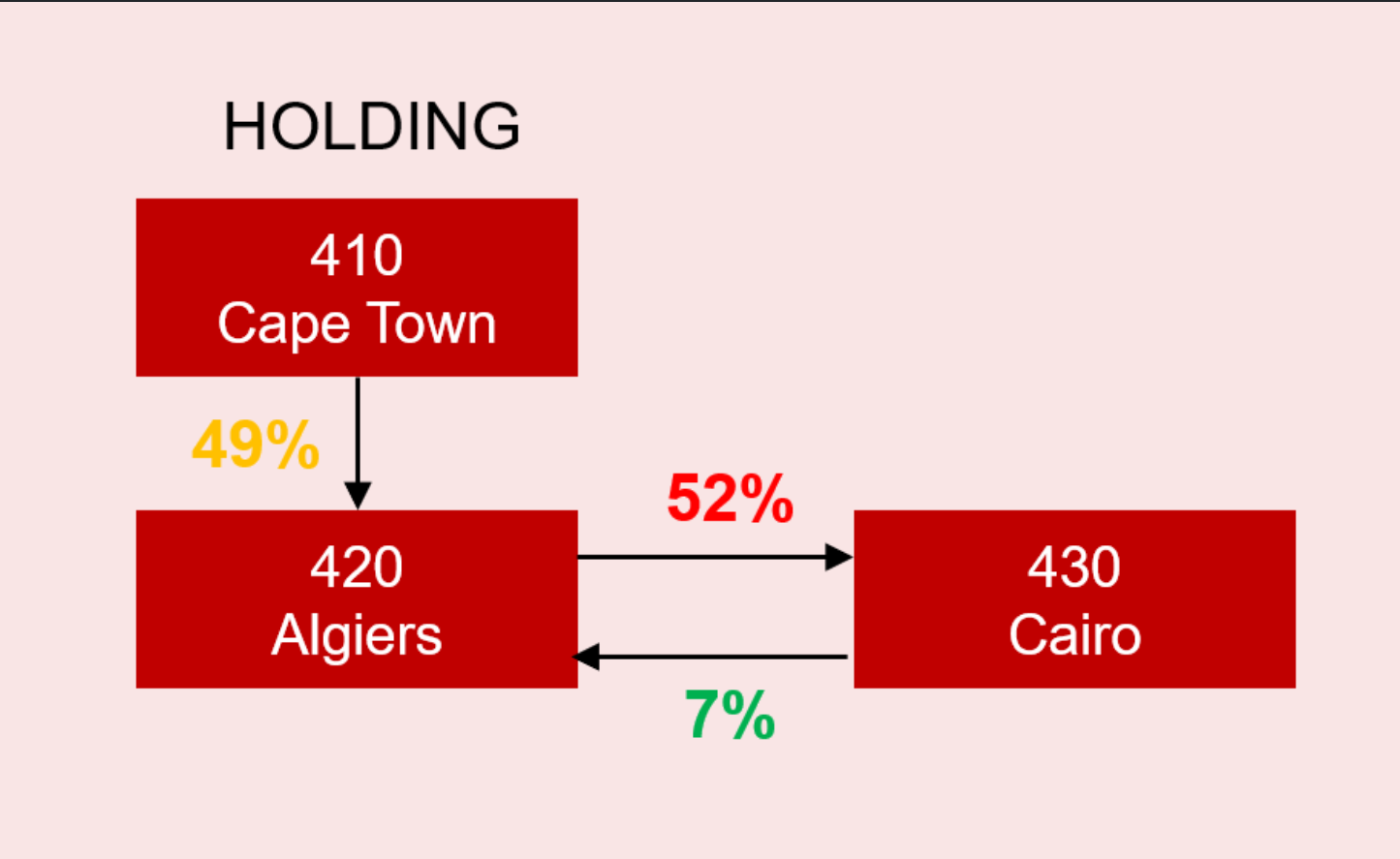
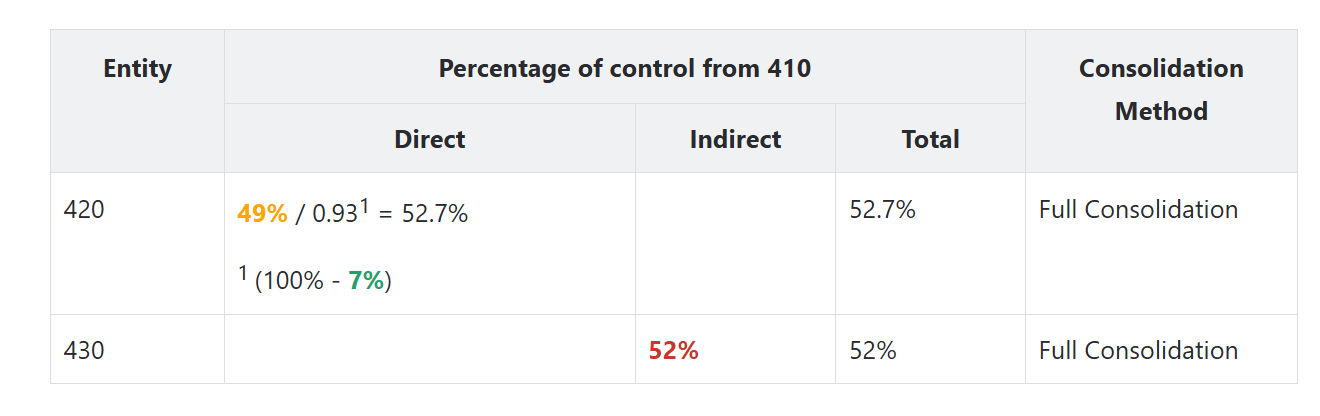
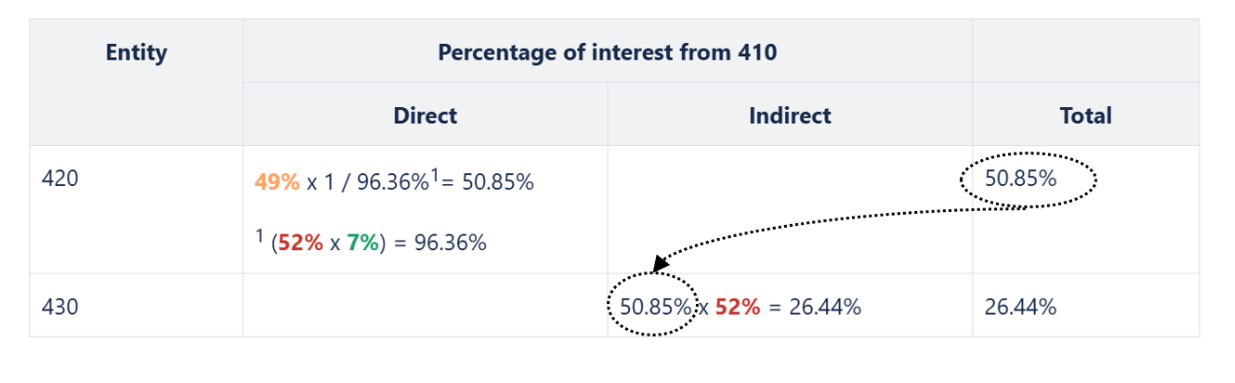
In this situation, company 420 owns 52% of company 430, while company 430 owns 7% of company 420. This creates a self-control situation, as company 420 owns more than 10% of company 430. Consequently, the percentage of voting rights that company 430 has over company 420 won't be considered when calculating the quorum.
To calculate the percentage of control of 420, we don't take a base of 100% but of 100% - 7%= 93%. The calculation will be: 49%/93%= 52.7%. This allows the 410 to gain sole control over the 420.
Business case 3
The principle for circular shareholdings is the same as for reciprocal shareholdings, for example:
- In calculating the percentage of control, when self-control exists among companies, the entity with the lower percentage must divest its shares and will be prohibited from exercising its voting rights.
- To determine how much interest is paid, a divisor is used for one of the companies that has circular holdings.
Calculating the divisor coefficient: 1- multiplication of circular interest percentages.
In this scenario, company 500 holds a 60% interest in company 510. Meanwhile, company 510 has a 15% interest in company 520. However, company 520 also holds a 20% interest in company 500. This creates a complex structure of circular ownership among these companies.
To determine the control percentage, we need to account for circular ownership.
- The calculation starts with company 500's direct ownership of 60% of company 510.
- Next, we need to adjust for the 15% interest that company 510 holds in company 520 and the 20% interest that company 520 holds in company 500. This requires iterative calculations to properly reflect the reduced control due to circular ownership.
- Company 500 will control less of company 510 than it did at first because company 520's ownership has more power.
Business case 4
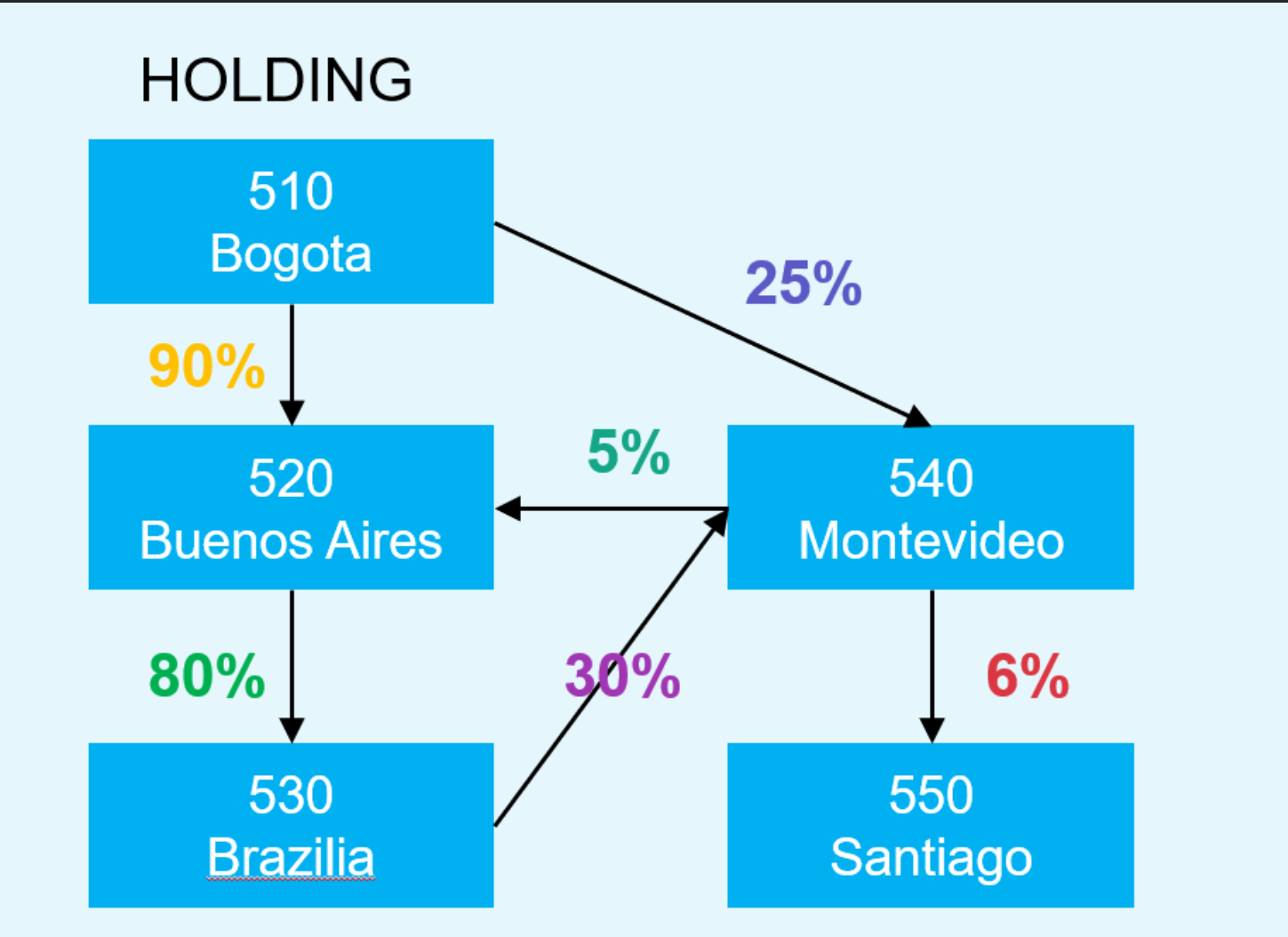
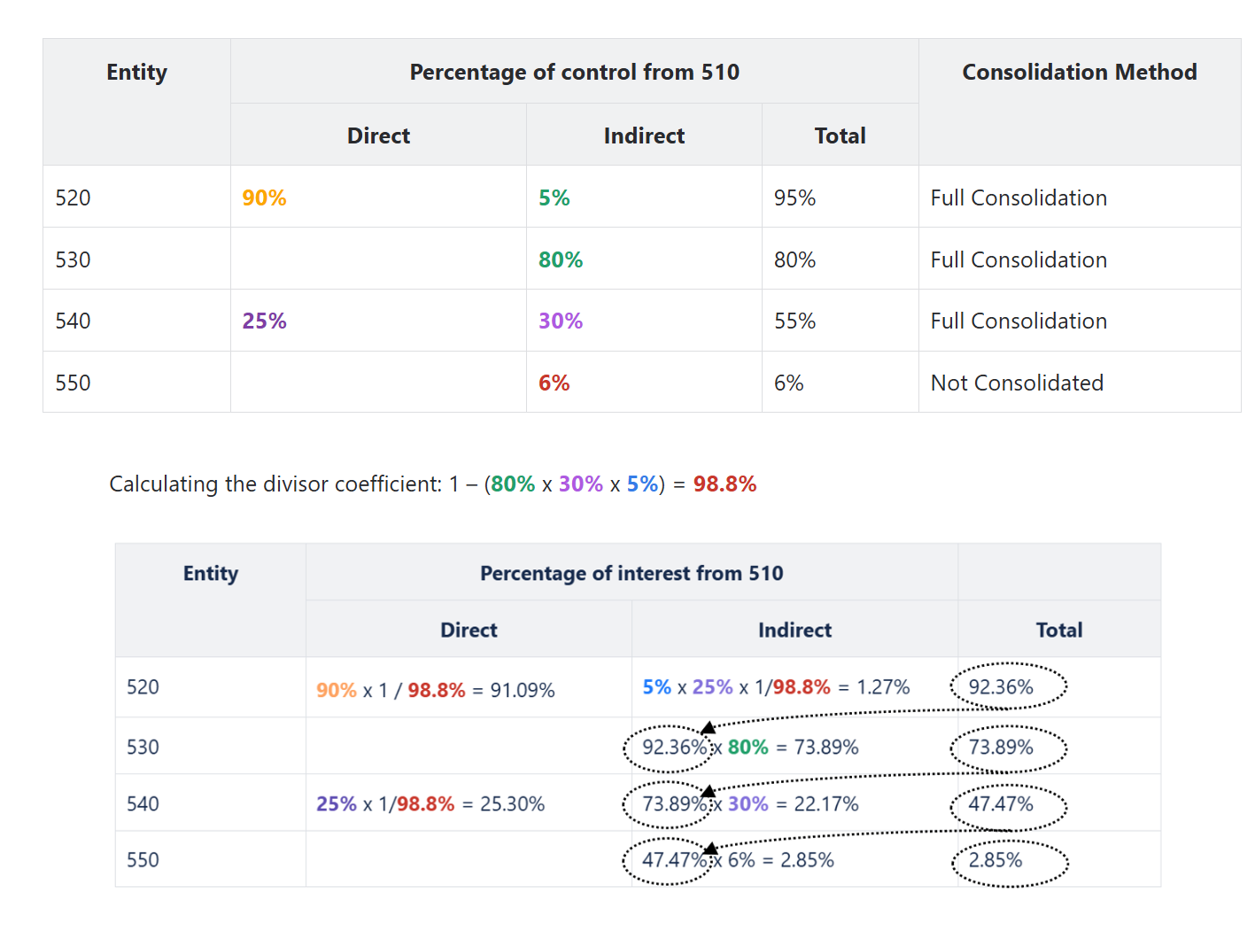
This example shows how hard it is to calculate control percentages when there are circular ownership structures.
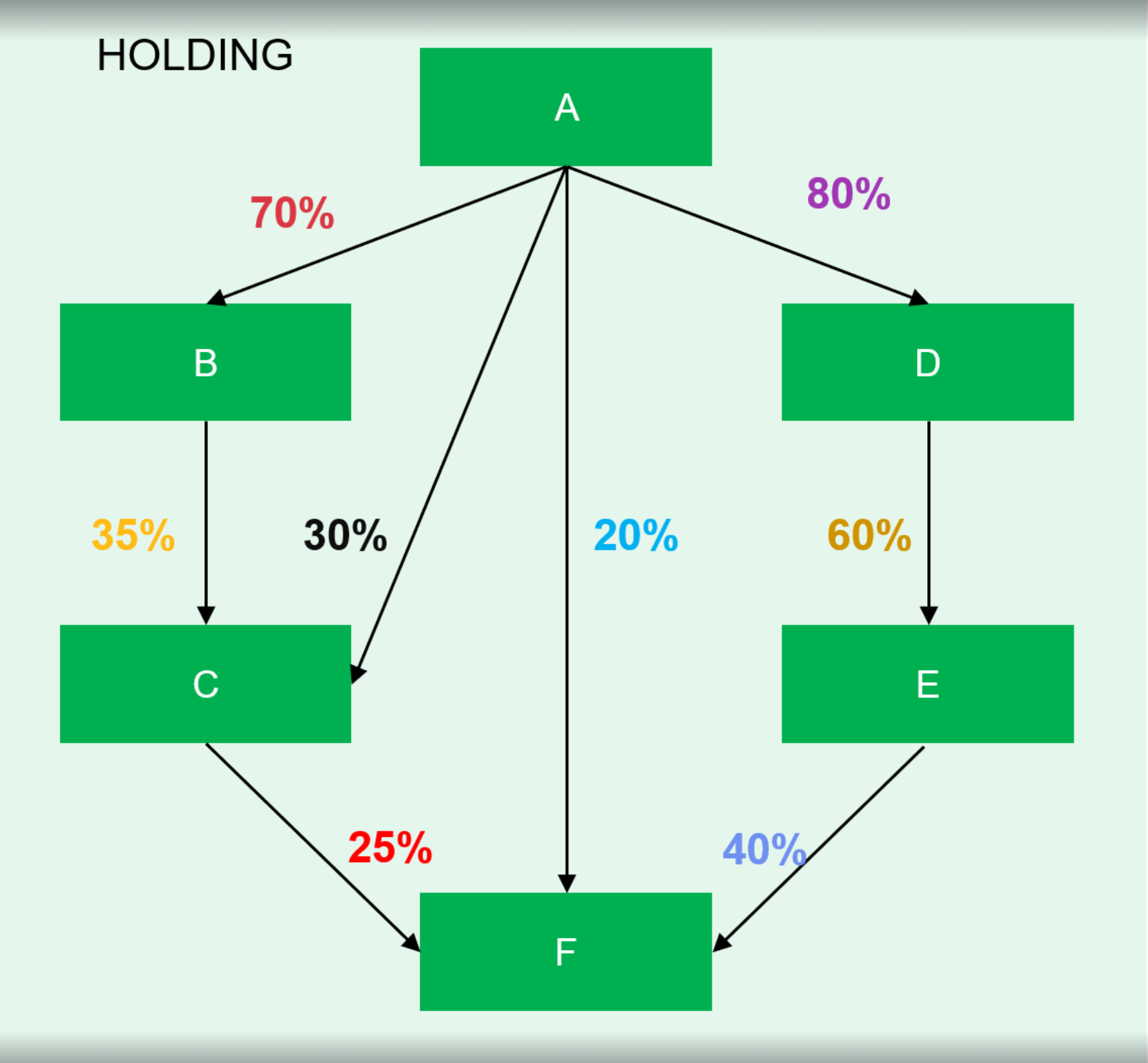
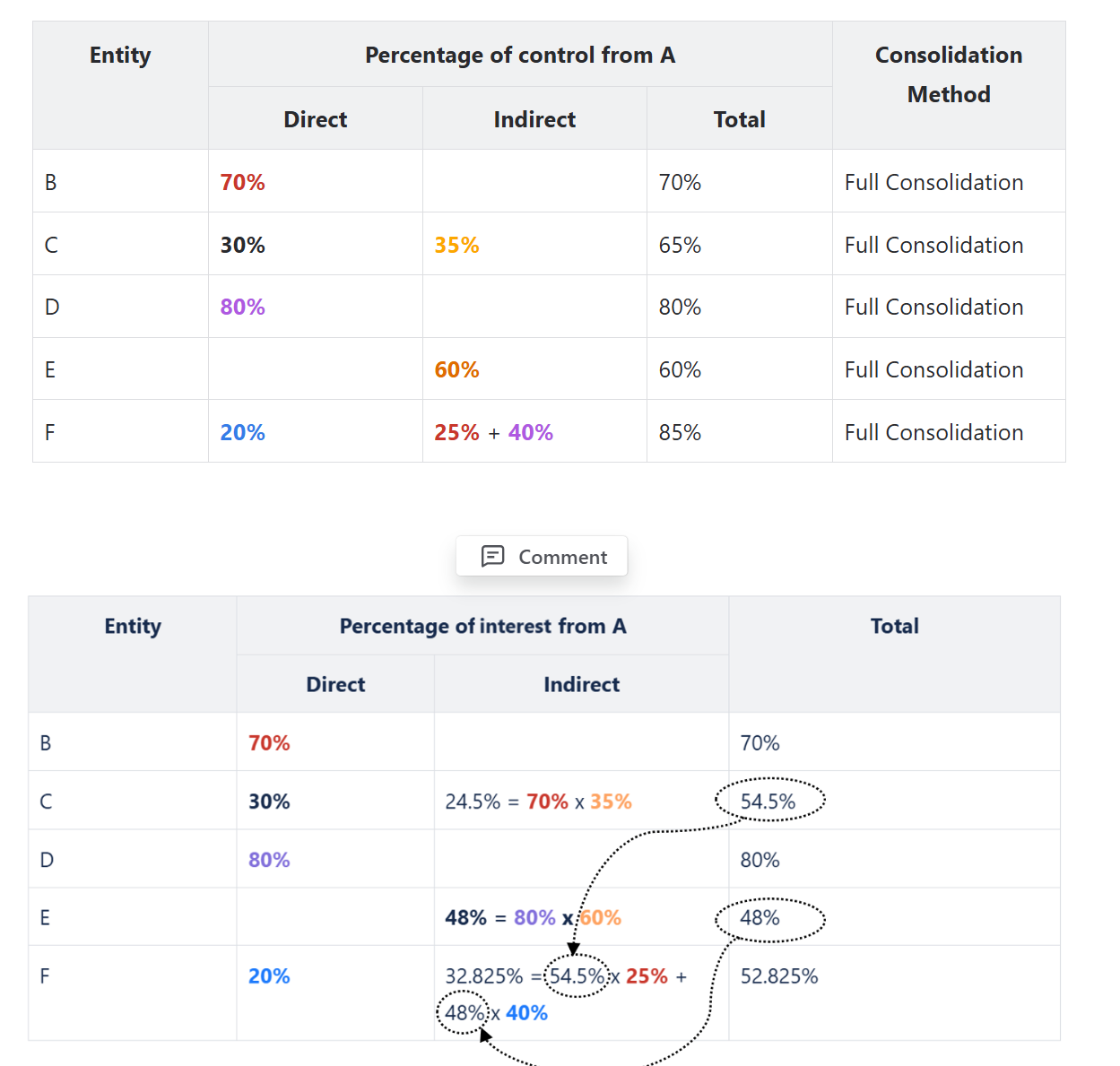
Business case 5
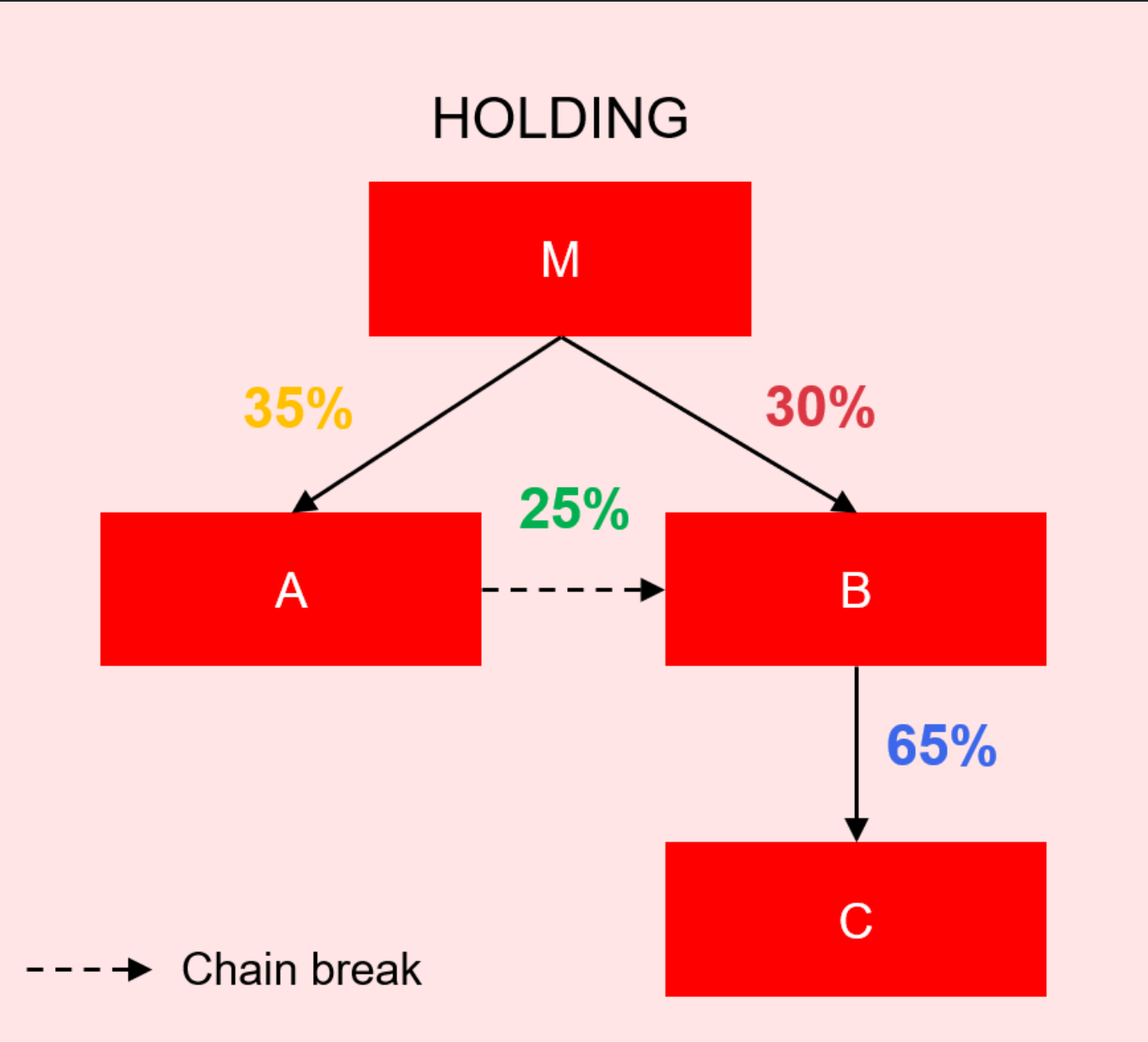
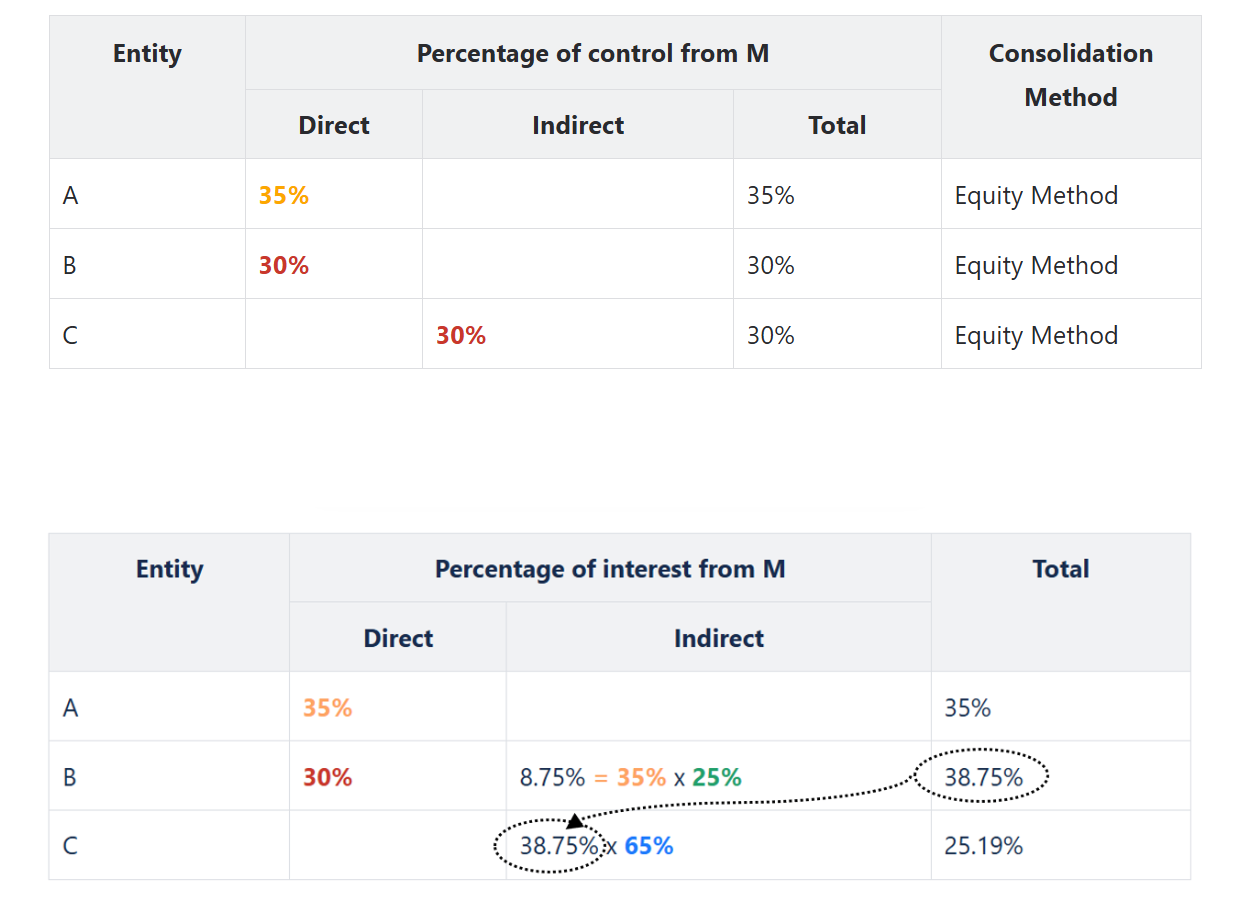
Business case 6
Business case 7
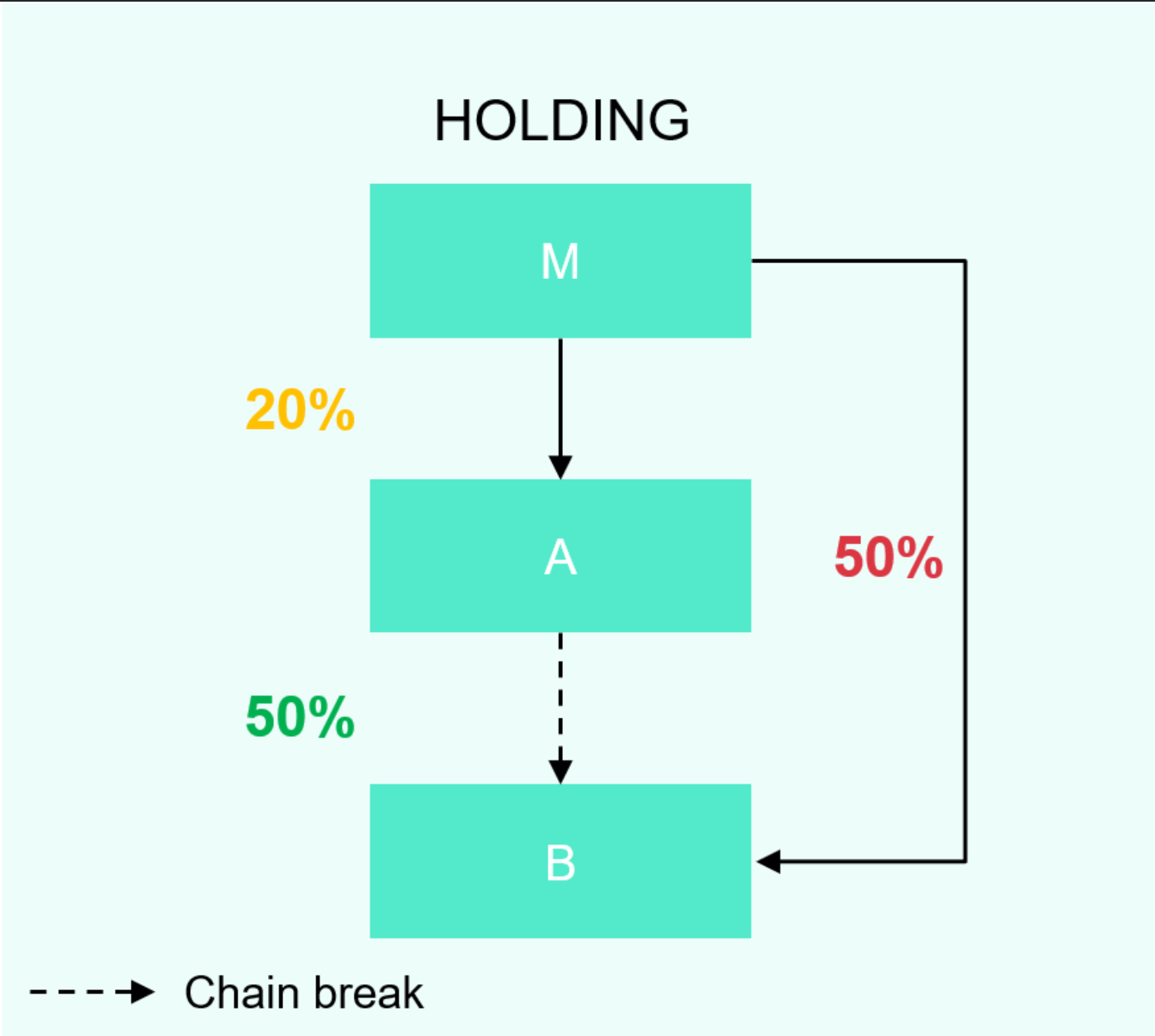
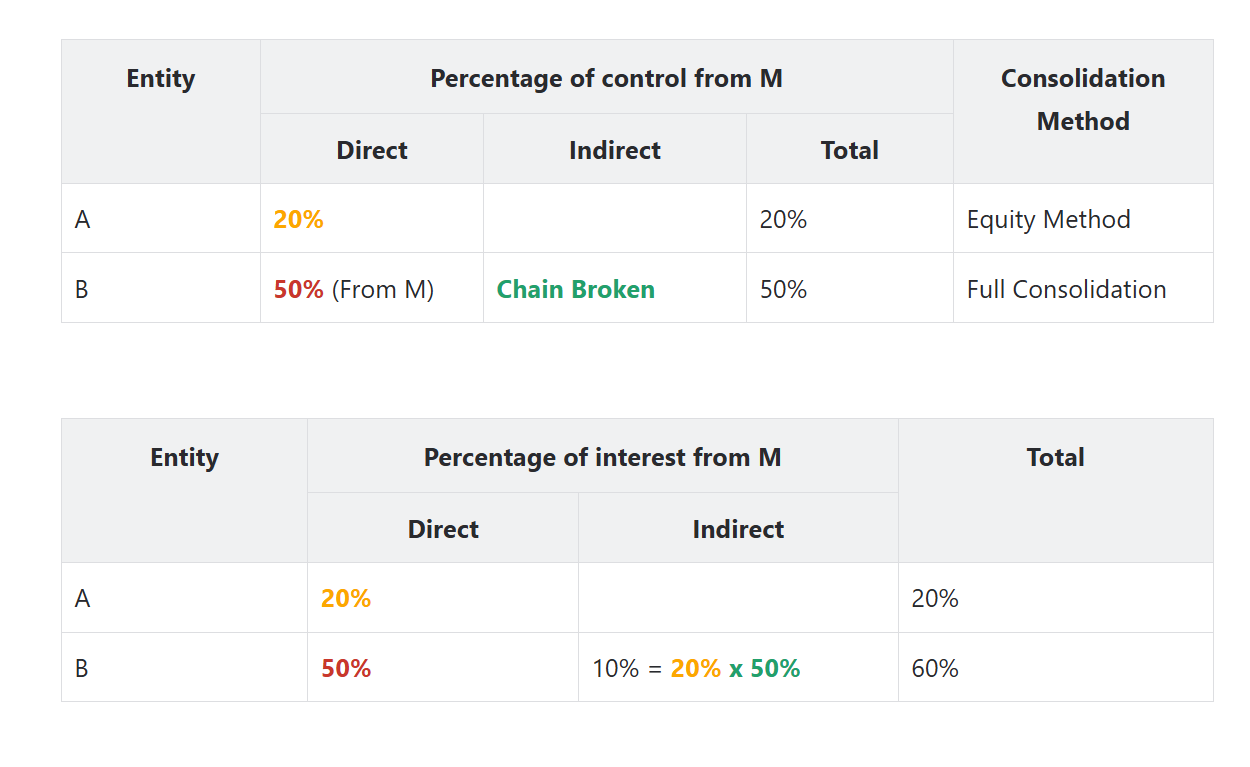
The chain break between A and B shows a break in the chain of control. Although M has a financial interest in A, this doesn't automatically give M control over B. M's control over B is indirect and is less than 50% because M's 50-percent interest in B is only through its 20-percent ownership of Company A.
Control Percentage vs. Interest Percentage:
- M's Interest Percentage: M's 20% interest in Company A represents its proportionate share of ownership and potential profits. This is a passive investment because M can't control Company A's operations and financial policies.
- M's Control Percentage (indirect): M indirectly holds a 10% interest in Company B (20% of A's 50% interest in B). Despite M’s financial interest in the chain, it doesn't have the ability to direct the activities of B. M doesn't have a controlling interest in B and has limited voting rights.
- Company A's Control Percentage: Company A holds a 50% interest and a 50% control percentage in Company B. This signifies a significant level of influence and the ability to shape B’s strategic direction.